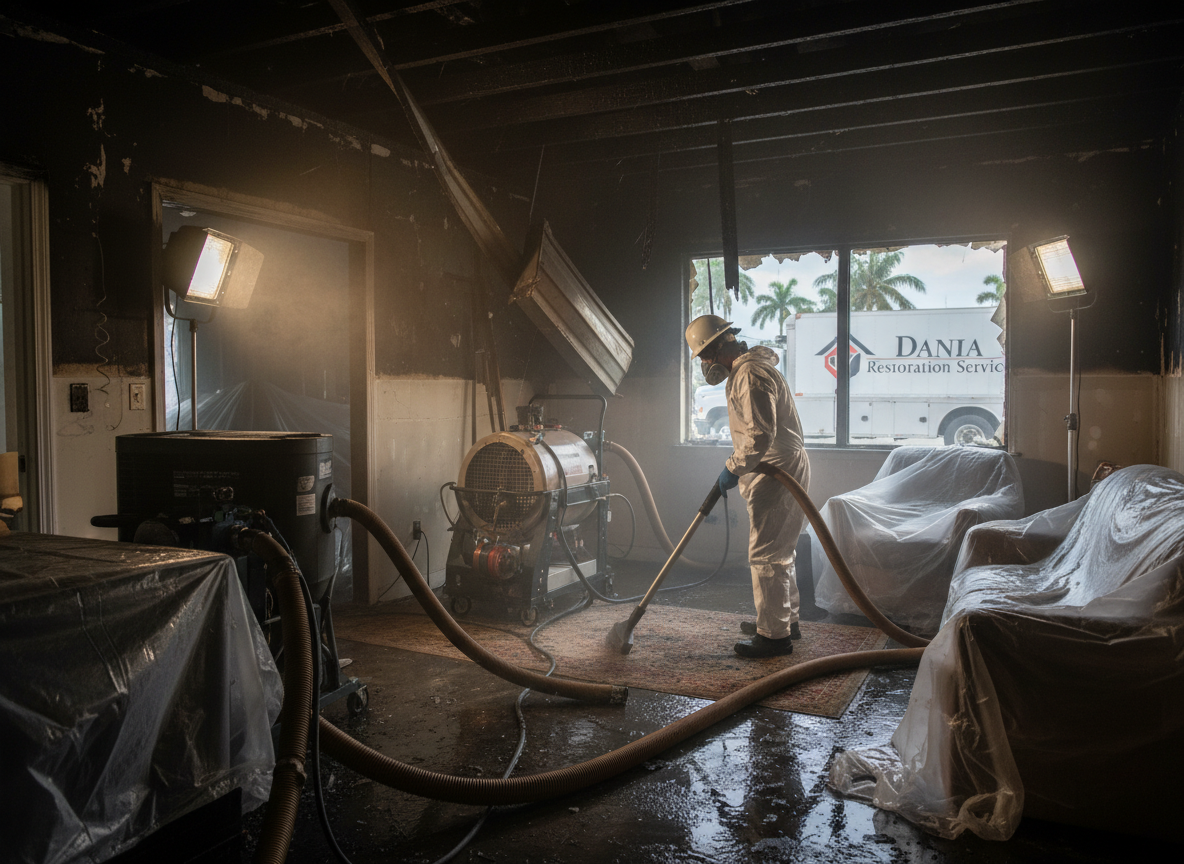
Firefighting water in Dania Beach homes often saturates older plaster and lath walls common in the Dania Beach Historic District, creating hidden pockets that standard fans cannot reach. High humidity from the tropical climate keeps moisture levels elevated for days after the initial event, raising the risk of secondary mold growth inside cavities near John U. Lloyd Beach State Park properties. Technicians must remove baseboards and drill inspection holes to confirm complete drying before any reconstruction begins.
In Broward County neighborhoods bordering Hollywood and Fort Lauderdale, many structures sit on slab foundations that trap water under tile or carpet after a fire. Soaked insulation and subflooring must be cut out rather than dried in place because residual salts from suppression chemicals accelerate corrosion on metal fasteners. Crews document every cut with photos for insurance adjusters while working around active electrical panels that survived the blaze.
Warm winter temperatures in Dania allow equipment to run continuously without freezing risk, yet the same conditions speed bacterial growth in standing water left behind carpets. Remediation teams prioritize negative air machines to contain soot particles stirred up during demolition, preventing cross-contamination into unaffected rooms. Final clearance testing checks both moisture content and airborne particulates before homeowners return.
Technician insight
In Dania, the thing that catches most people out with water damage remediation after fire is how quickly humidity from the ocean side seeps back into freshly cut wall cavities if you do not keep negative pressure running overnight. Homes in the Historic District often have multiple layers of plaster over lathe that hold moisture longer than modern drywall, so skipping the extra inspection holes means mold shows up weeks later.
Slab Leak After Kitchen Fire
Water from suppression pooled under tile in a Dania Beach home near the casino. We found saturated subfloor extending into the living room. Extraction and targeted removal of wet plywood stopped further migration into the adjacent hallway. The structure dried within four days and passed clearance without mold issues.
How it works
- 1
Initial Assessment
Technicians inspect all affected rooms, map water migration paths, and test moisture levels in walls, floors, and ceilings.
- 2
Water Extraction
Portable pumps and vacuums remove standing water from slabs and low-lying areas before demolition starts.
- 3
Selective Demolition
Wet drywall, insulation, and flooring are removed in controlled sections to prevent soot spread.
- 4
Drying and Monitoring
Air movers, dehumidifiers, and moisture meters run until readings match unaffected materials.
- 5
Final Clearance
Visual inspection plus meter checks confirm the structure is dry and ready for repairs.
Pricing
Cost depends on square footage affected, depth of water penetration into older construction, and length of drying time required by local humidity.